Watch: Did Livia Kill Augustus? Unravelling Roman Gossip
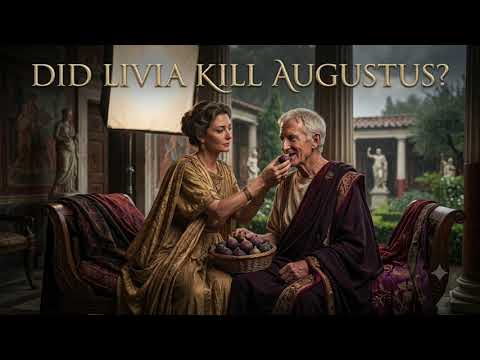
A closer look at the succession from Augustus to Tiberius, and the ancient rumours surrounding Livia’s role in it.
Watch on YouTube ↗A succession prepared in advance
By the last years of his reign, Augustus had given his stepson and adopted son Tiberius tribunicia potestas — the tribune’s power of veto and personal inviolability — and maius imperium, authority over the provinces and armies equal to his own. When Augustus died at Nola on 19 August 14 CE, at the age of seventy-five, Tiberius already held the practical machinery of rule; the Senate’s confirmation was a formality rather than a contest. This part of the story is not in dispute among ancient or modern historians.
The heirs who came before him
Tiberius was never Augustus’s first choice. Augustus had favoured, in turn, his nephew Marcellus, his general and son-in-law Agrippa, and his two adopted grandsons, Gaius and Lucius Caesar — all of whom died before him: Marcellus in 23 BCE, Agrippa in 12 BCE, Lucius in 2 CE, and Gaius in 4 CE. Tacitus records that suspicion fell on Livia, Augustus’s wife and Tiberius’s mother, for clearing a path for her own son (Annals 1.3). Modern historians are generally skeptical of the accusation: sudden death was common in a world without modern medicine, illness and campaign wounds are independently attested for both Gaius and Lucius, and Roman writers were quick to blame ambitious women for political outcomes they found otherwise hard to explain. This archive does not treat the poisoning claim as demonstrated — only as the accusation Tacitus himself already flagged as unproven.
Agrippa Postumus, exiled
By 4 CE, the deaths of Gaius and Lucius left Augustus’s biological grandson Agrippa Postumus as his only surviving direct descendant. Augustus adopted both Postumus and Tiberius that year, but ancient sources describe Postumus as violent and unsuited to public life; within two or three years Augustus had him formally disinherited and exiled to the island of Planasia, with the Senate’s approval (Suetonius, Augustus 65; Tacitus, Annals 1.3). Tacitus notes Livia’s hostility toward Postumus as background to the exile, but the ancient record attributes the decision itself to Augustus, not to Livia acting alone.
The poisoned figs
Cassius Dio records a specific and famous rumor: that in 14 CE, fearing Augustus might reconcile with Postumus and reverse the succession, Livia smeared poison onto figs still ripening on the trees in Augustus’s private garden — fruit he was known to pick and eat himself, believing it safe from tampering in his kitchen (Roman History 56.30). Dio reports this as a story in circulation, not as something he witnessed or could confirm. A gentler alternative reading, floated by some ancient and modern writers alike, is that if Livia hastened her husband’s death at all, it may have been to spare a dying seventy-five-year-old man further suffering, with his own knowledge. Both readings remain speculation about a death that needs no poison to explain.
The execution of Agrippa Postumus
The strangest documented fact in this story comes directly after Augustus’s death: Tacitus opens the Annals by recording that Agrippa Postumus was executed by the centurion guarding him almost immediately afterward. When the centurion reported it, Tiberius denied giving the order and threatened an inquiry that never happened (Annals 1.6). Tacitus himself says responsibility was never established — whether a standing order left by Augustus, an instruction from Tiberius, or an act carried out on Livia’s authority. This archive does not resolve it either; it is one of the genuine unsolved questions of the reign’s opening days, not a settled fact this site can assert either way.
What can, and can’t, be said
The constitutional transfer of power from Augustus to Tiberius is not in doubt. What remains genuinely uncertain is how much of the clearing of the field around him was engineered, and by whom. Ancient historians hostile to the dynasty had every reason to blame a powerful woman for outcomes that were politically convenient — that does not make the accusations true, but it does not make them empty invention either. See Augustus, Livia, and Tiberius’s own profiles for the wider context, and the academic sources page for the full bibliography behind this account.