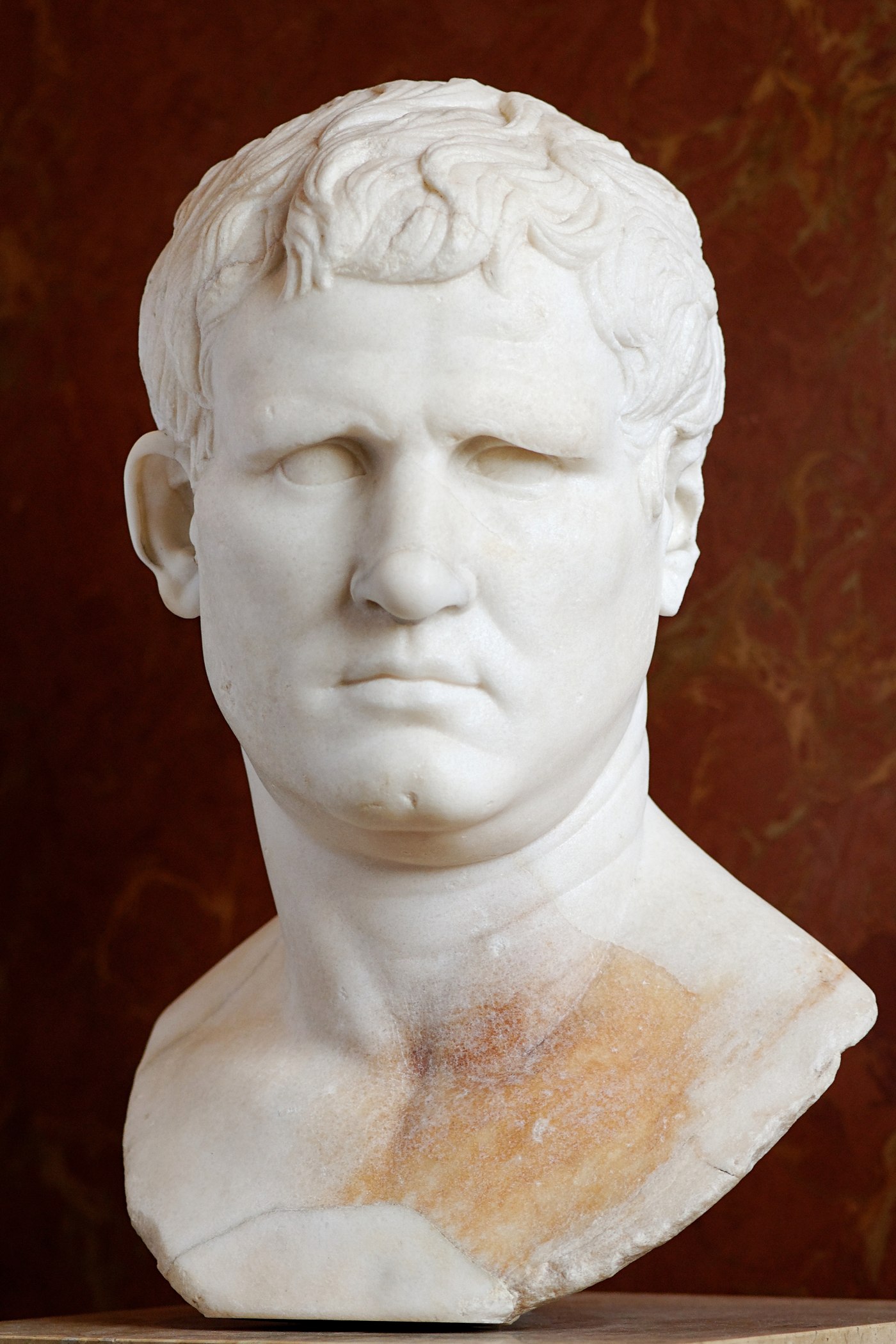
The general who won Augustus’s wars
Marcus Vipsanius Agrippa was a childhood friend and fellow student of the young Octavian, and became by far his most capable general. Agrippa commanded the decisive naval victories that secured Octavian’s rise: over Sextus Pompey at Naulochus in 36 BCE, and over Marcus Antonius and Cleopatra at Actium in 31 BCE, the battle that left Octavian without a rival for power.
Builder of Rome, and the emperor’s chosen deputy
Beyond the battlefield, Agrippa built much of the physical fabric of Augustan Rome, including the original Pantheon, aqueducts, and public baths that carried his name. During a serious illness in 23 BCE, Augustus is said to have given Agrippa his signet ring, a gesture widely read as naming an intended successor. In 21 BCE, after the death of Augustus’s son-in-law Marcellus, Augustus married Agrippa to his own daughter, Julia the Elder, binding his most trusted deputy directly into the family.
Father of a generation of heirs
Agrippa and Julia had five children together — Gaius Caesar, Lucius Caesar, Julia the Younger, Agrippina the Elder, and Agrippa Postumus — several of whom Augustus adopted outright as his own prospective heirs. Agrippa died in 12 BCE, before any of his sons could reach the throne he had done so much to secure; through Agrippina the Elder, he was nonetheless an ancestor of Caligula and Nero.
Historical sources
Cassius Dio, Roman History 49–51
Agrippa’s naval commands at Naulochus and Actium.
Suetonius, Augustus 63; 66
Agrippa’s marriage to Julia and his closeness to Augustus.
Portrait: Marie-Lan Nguyen / Wikimedia Commons, CC BY 2.5. Resized for display.