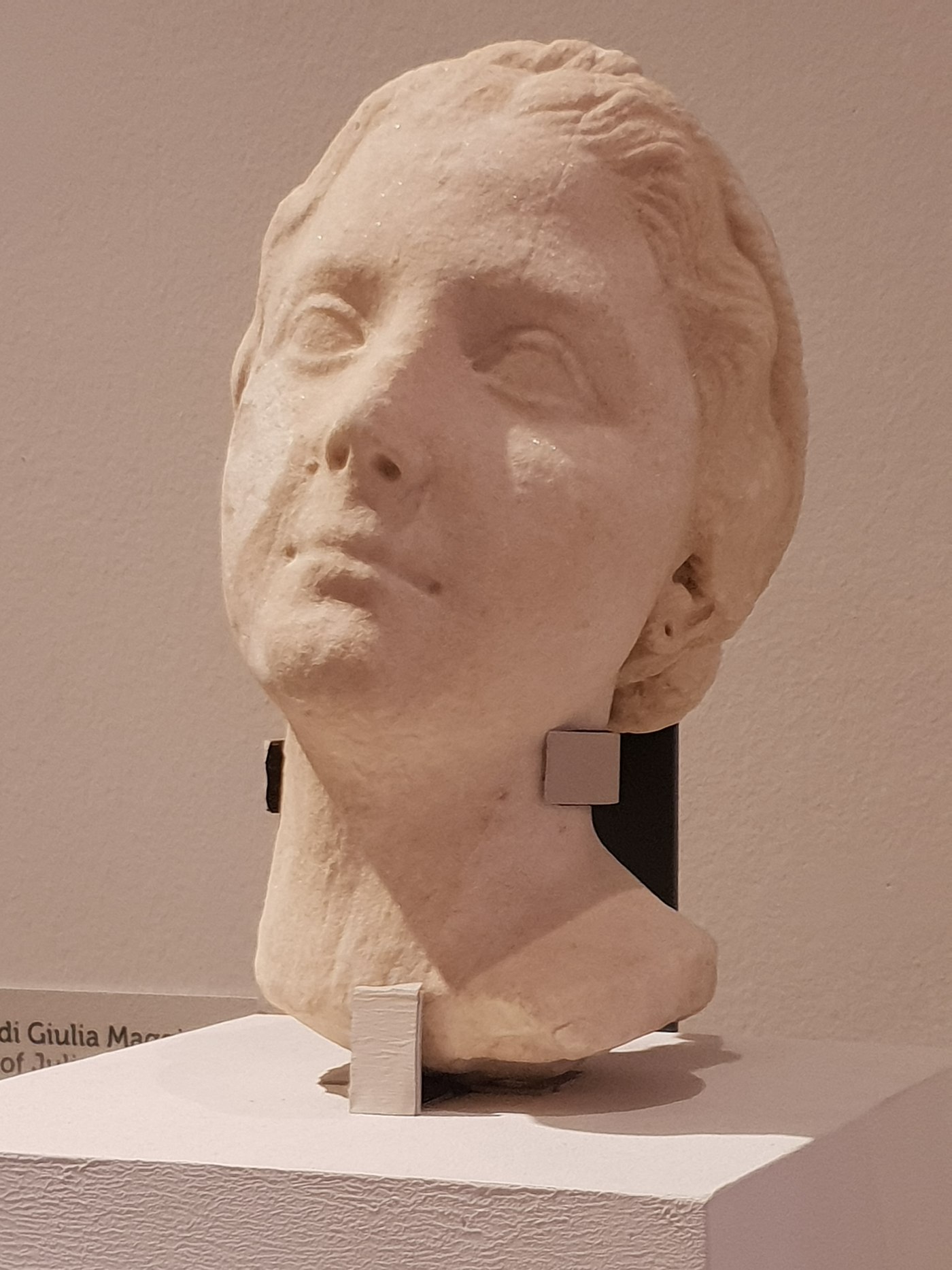
A granddaughter caught in the same net as her mother
Julia the Younger was a daughter of Julia the Elder and Agrippa, and so a granddaughter of Augustus and a sister of Gaius Caesar, Lucius Caesar, Agrippina the Elder, and Agrippa Postumus. In 8 CE — five years after her mother’s own exile on similar charges — Augustus exiled Julia the Younger for adultery.
Politics or scandal, or both
Some modern historians suspect the charge concealed a political conspiracy connected to her husband’s circle or to her brother Agrippa Postumus, rather than simple personal misconduct, though the ancient sources do not spell out such a plot. Augustus banished her lover, the senator Decimus Junius Silanus, and sent Julia to the island of Trimerus.
Twenty years in exile
Julia lived in exile for around two decades, outlasting Augustus, whose will — like his response to her mother’s exile — pointedly forbade her burial in his mausoleum. She died around 28 CE, well into Tiberius’s reign, having spent most of her adult life removed from the family whose succession politics had condemned her.
Historical sources
Tacitus, Annals 4.71
A retrospective mention of Julia’s long exile.
Suetonius, Augustus 65
Augustus’s exile of his granddaughter and the ban on her burial in his mausoleum.
Portrait: Jamie Heath / Wikimedia Commons, CC BY-SA 2.0. Resized for display.