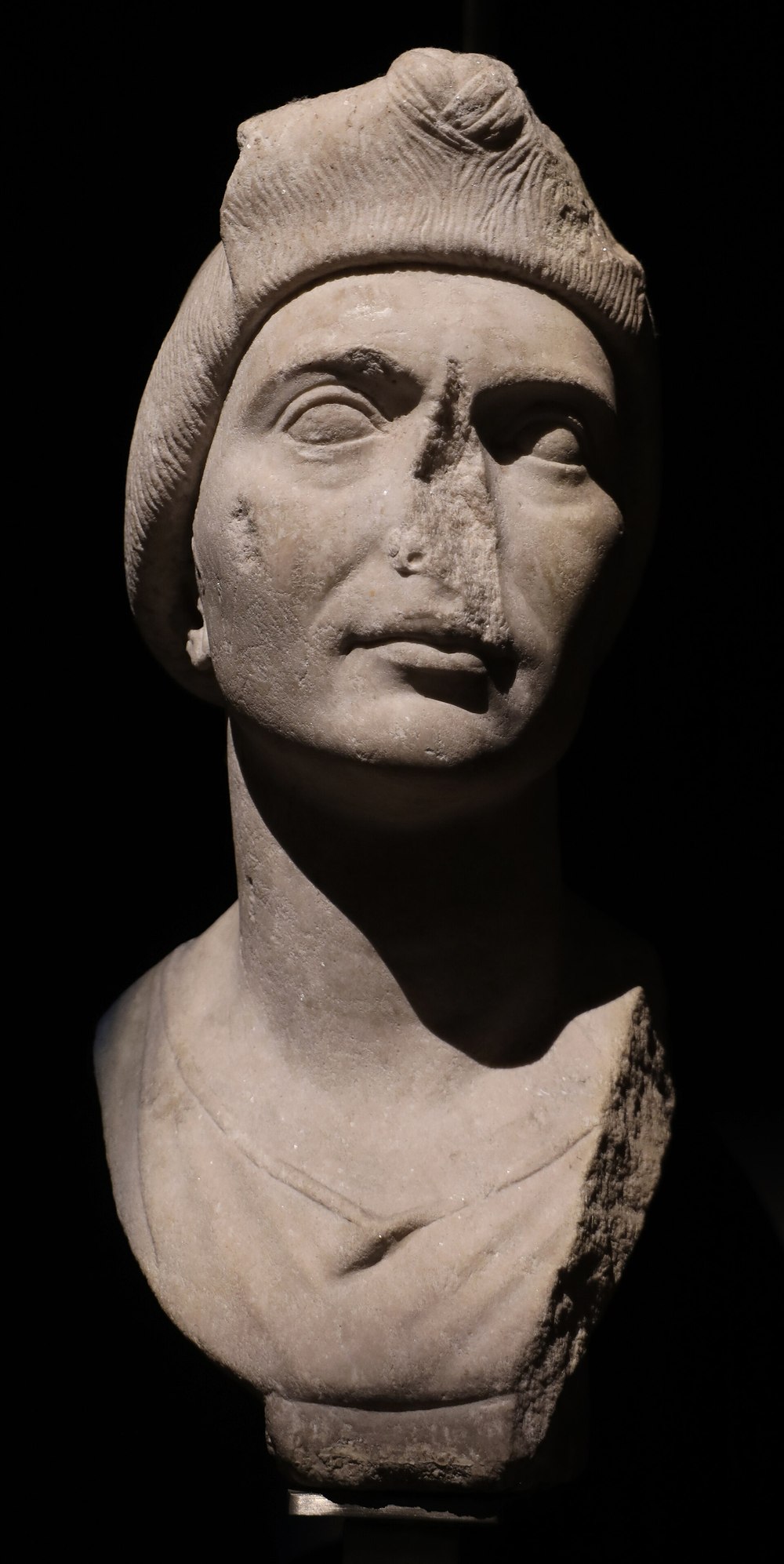
A marriage that bought the Republic time
Octavia was the elder sister of the future Augustus. Widowed by the death of her first husband, Gaius Claudius Marcellus, she married Marcus Antonius in 40 BCE as the human seal on the Treaty of Brundisium, a truce between her brother and her new husband. The couple had two daughters, Antonia Major and Antonia Minor, before Antonius’s duties kept him increasingly in the eastern Mediterranean.
Dignity in a public humiliation
As Antonius’s relationship with Cleopatra VII became public and politically inconvenient for him, he divorced Octavia in 32 BCE. Ancient writers contrast her composed, dutiful public image with Antonius’s conduct: she continued to raise her own children alongside his children by Fulvia and by Cleopatra in her own household, conduct that Augustus’s propaganda used effectively against Antonius.
Grief, honour, and a dynasty’s women
Octavia’s son from her first marriage, Marcellus, died young in 23 BCE, a loss ancient sources describe her as never fully recovering from; Virgil is said to have reduced her to tears reciting the lines on Marcellus in the Aeneid. She died in 11 BCE and received a public funeral; Augustus and Tiberius delivered eulogies, and the Porticus Octaviae in Rome preserved her name. Through her daughters she became grandmother to Germanicus and Claudius and great-grandmother to Caligula and Nero.
Historical sources
Plutarch, Life of Antony 31; 54; 57
Her marriage, her household, and the divorce.
Suetonius, Augustus 61; 63
Augustus’s family honours and the marriages of Octavia’s children.
Virgil, Aeneid 6.860–886
The passage said to have moved Octavia to grief for Marcellus.
Portrait: Francesco Bini / Wikimedia Commons, CC BY-SA 4.0. Resized for display.